
The Structure behind COYM
Books and Practice.

The 3 Phases
Master the Basics is the first phase of the Chronicles of Your Mind workbooks and marks the entry point into the personal growth process. In this phase, foundational competencies are developed through daily practice before deeper self-reflection, emotional processing, and engagement with more profound layers of human experience begin.
The focus starts with core mechanisms of attention and focus, without which learning itself is not possible, and progresses toward the most under-estimated foundational skill: patience. Human change is possible, but it requires time. When patience is absent, growth collapses. This phase provides all essential elements needed to establish a stable foundation for learning, develop-ment, and lasting personal change.
Master the Emotions is the second part of the Chronicles of Your Mind series and focuses entirely on emotions: how to experience them consciously, how to develop different perspectives, and how to understand their biochemical dimension. This process helps shift awareness out of the mind and habitual self-narratives, enabling a clear distinction between inner experience and outer reality.
These are only some of the competencies addressed within the domain of emotional intelligence in this series. Skillful engagement with emotional states fosters self-determination and opens possibilities that are often difficult to imagine, impacting health, success, and the capacity to live a fulfilled life.
Master the Pinnacles focuses on lived reality and the practical implementation of inner development. This phase addresses concrete themes and key life domains. Building on the skills developed in the first two phases, deeply rooted beliefs, projections, and inherited patterns are examined with precision, enabling self-responsible action, conscious life design, and the release of unresolved burdens.
This phase represents the highest level of the process. These books should not be used without the grounding provided by the first two phases, as doing so significantly increases the risk of misinterpretation and unconscious projection, leading to distorted results rather than meaningful change.
Master The Basics
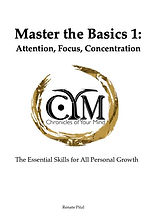

Master the Basics 1: Attention, Focus, Concentration is deliberately positioned as the first book of the series. Without these abilities, learning itself is not possible. While the terms attention, focus, and concentration are widely used, the distinctions between them are rarely understood and even fewer people have consciously experienced their different functional modes. Many failed attempts at personal change and life improvement can be traced back to the absence of this foundational layer. Understanding how attention and focus operate, how they are experienced, and how they are applied in practice is an essential part of building a stable foundation for learning, development, and lasting change.
Master the Basics 2: Observing Thoughts is deliberately positioned as the second book of the series. Without the ability to observe and monitor one’s own thoughts, emotional regulation, self-reflection, and deliberate personal growth are severely limited. While terms such as meta-awareness, thought observation, and cognitive decentering are increasingly discussed, few people have consciously practiced observing their thoughts as separate from their identity or automatic reactions. Many patterns of rumination, impulsive behavior, and emotional reactivity can be traced back to the absence of this foundational skill. Understanding how thoughts arise, how they can be noticed without immediate reaction, and how this observation can be applied in structured exercises is an essential part of building a resilient foundation for emotional intelligence, reflective learning, and sustainable personal development.


Somatic Awareness is deliberately positioned as the third book of the series. Without the ability to perceive and observe bodily sensations clearly, emotional regulation, self-understanding, and deliberate personal growth remain unstable and imprecise. While terms such as body awareness, mindfulness, and interoception are increasingly discussed, few people have consciously practiced observing their bodily sensations without immediately interpreting, analyzing, or reacting to them. Many patterns of emotional reactivity, stress responses, and impulsive behavior originate at the level of the body before they become conscious thoughts. When these early signals are not perceived accurately, reactions tend to feel automatic and difficult to regulate. Learning to notice sensations as they arise, to distinguish them from thoughts and emotions, and to remain with them without interference is a foundational skill. It creates the conditions for recognizing internal changes earlier, responding more deliberately, and building a more stable and reliable form of self-awareness. Developing somatic awareness is therefore not an advanced technique, but a necessary step in establishing a precise and functional basis for emotional intelligence, reflective learning, and sustainable personal development.
Emotional Observation is deliberately positioned as the fourth book of the series. Without the ability to detect and observe emotions clearly, emotional regulation, self-understanding, and deliberate personal growth remain incomplete and unreliable. While terms such as emotional intelligence, emotional awareness, and self-regulation are widely discussed, few people have consciously practiced observing emotions as they arise without immediately reacting, analyzing, or trying to change them. Many patterns of impulsive behavior, distorted decision-making, and repeated internal conflict begin with emotions that were never clearly recognized in the first place. When emotional states are not perceived accurately, reactions tend to feel automatic and difficult to regulate. Learning to notice emotions early, to distinguish between subtle emotional states, and to separate emotions from thoughts and bodily sensations is a foundational skill. It creates the conditions for recognizing internal shifts sooner, reducing emotional reactivity, and responding with greater precision instead of habit. Developing emotional observation is therefore not an advanced technique, but a necessary step in establishing a clear and functional basis for emotional intelligence, reflective self-awareness, and sustainable personal development.


Impartiality is deliberately positioned as the fifth book of the series. Without the ability to distinguish direct observation from automatic interpretation, perception easily becomes fused with assumptions, emotional reactions, judgments, and prior conditioning. In this state, thoughts and interpretations are often experienced as objective reality itself rather than as internally constructed mental processes. While concepts such as open-mindedness, objectivity, and critical thinking are widely discussed, few people have consciously practiced observing how rapidly the mind forms conclusions, assigns meaning, generates certainty, and emotionally commits to interpretations. Many recurring conflicts, distorted perceptions, reactive behaviors, and rigid patterns of thinking emerge not from reality itself, but from interpretations that were never clearly recognized as interpretations in the first place. Learning to observe judgments as they form, to recognize the influence of emotions on perception, and to separate direct experience from automatic meaning-making is therefore a foundational cognitive skill. It creates the conditions for reduced reactivity, greater psychological flexibility, more accurate self-observation, and more deliberate responses under emotionally activating conditions. Developing impartiality is therefore not about suppressing emotion, eliminating judgment, or becoming passive. It is the development of increased awareness of how perception, interpretation, and emotional certainty interact internally. This awareness forms an essential foundation for metacognition, emotional regulation, cognitive flexibility, and sustainable personal development.
Perspective Expansion is deliberately positioned as the sixth book of the series. After learning to distinguish observation from interpretation in Impartiality, the next step is recognizing that every interpretation represents only one possible perspective among many. Without this ability, the mind tends to treat its first explanation as the only valid one, narrowing perception and limiting cognitive flexibility. While concepts such as open-mindedness, perspective-taking, and tolerance of uncertainty are widely discussed, few people have consciously practiced remaining open when multiple interpretations are possible. The mind naturally seeks coherence, certainty, and predictability. As a result, alternative explanations are often dismissed before they are fully considered, and subjective interpretations can quickly become experienced as objective reality. Many interpersonal conflicts, rigid beliefs, communication breakdowns, and unnecessary emotional reactions arise not because situations are inherently clear, but because alternative perspectives were never actively explored. The ability to recognize ambiguity, generate multiple interpretations, and tolerate temporary uncertainty is therefore a foundational cognitive skill. It allows perception to become more flexible, reduces premature conclusions, and creates space for more accurate understanding. Developing perspective expansion is therefore not about abandoning convictions, avoiding decisions, or accepting every viewpoint as equally valid. It is the development of greater cognitive flexibility and the ability to recognize that perception is always influenced by perspective. This capacity forms an essential foundation for adaptive thinking, effective problem-solving, emotional regulation, constructive dialogue, and lifelong learning.

Patience is deliberately positioned as the seventh book of the series. After developing the ability to recognize thoughts, emotions, bodily sensations, interpretations, and perspectives more clearly, the next challenge is remaining engaged with the learning process long enough for meaningful change to occur. Without patience, many valuable insights never have sufficient time to become stable skills. While concepts such as self-control, perseverance, and delayed gratification are widely discussed, few people have consciously practiced the underlying processes that make patience possible. The mind naturally prefers immediate rewards, immediate certainty, immediate relief, and visible progress. As a result, goals are often abandoned prematurely, learning processes are interrupted, and long-term development is sacrificed for short-term comfort. Many unfinished projects, broken habits, abandoned routines, and repeated cycles of frustration emerge not because people lack intelligence, motivation, or potential, but because discomfort, uncertainty, and delayed results become difficult to tolerate. When progress cannot yet be seen, the mind often interprets the absence of immediate evidence as the absence of progress itself. The ability to remain present despite delayed outcomes is therefore a foundational skill. It allows individuals to tolerate frustration without immediately escaping it, observe impulses without automatically acting on them, remain engaged during uncertainty, and continue pursuing long-term goals when immediate rewards are unavailable. These capacities create the conditions required for learning, habit formation, emotional development, and lasting behavioral change. Developing patience is not about passive waiting, resignation, or suppressing desires. It is the development of greater self-regulation and the ability to remain aligned with a chosen direction despite temporary discomfort, uncertainty, or delayed gratification. This capacity supports long-term goal achievement, emotional stability, adaptive decision-making, resilience, and the sustained effort required for meaningful personal growth.
Master The Emotions
FURTHER TITLES IN DEVELOPMENT